
How Does Spray Cork or Cork Plaster Compare to PIR Insulation in the UK? A complete guide.
- Daniel Turk
- Apr 21
- 5 min read

We get asked all the time:“What thickness is your material?” With cork coatings, thickness on its own isn’t the full story
Performance is about the system and the outcome, not just a single mm number.
In this guide we’ll explain:
What thickness does (and doesn’t) tell you
The difference between lambda and R-value
Why comparing Cork Plaster to PIR board is usually misleading
What thickness we typically see on real jobs

Why thickness isn’t the full story
If you’re insulating a solid wall home, you’re usually trying to improve one (or more) of these outcomes:
Warmer internal surfaces (comfort)
Fewer cold spots (especially at corners and window reveals)
Lower condensation and mould risk
Better airtightness and fewer draughts
A breathable build-up that lets old walls dry
Thickness matters, but only in context. The substrate, existing build-up, moisture behaviour, and the problem you’re trying to solve all change what “good” looks like.
The spec people mix up
A key spec that gets mixed up is lambda (thermal conductivity).
Not "Larbarda", Lambda.
Our cork based coatings (at the time of writing this post Feb 2026), sit in the 0.04–0.07 W/mK range depending on which product you’re using, we have more than one in our range.
Lambda is a material property. It doesn’t change just because you apply 1mm or 10mm.
What does change with thickness is the R-value (thermal resistance).
More thickness generally means more thermal resistance, but you can’t give a meaningful “equivalent thickness” to another insulation without knowing:
The substrate (brick, stone, block, plaster)
The existing layers (paint, gypsum, cement render, wallpaper)
The moisture behaviour of the wall
The target outcome (comfort, mould reduction, deep retrofit U-value)
Wall make up solid or cavity
Space and area
Retrofit fixtures and fitting, pipes, cables.
Ventilation measures in place
Cork Plaster and Cork Spray Insulation: what they are (and what they’re for)
Cork plaster is a seamless, breathable cork insulation coating system. It can be applied to smooth surfaces, and some cork systems can also be sprayed directly to brickwork.
These systems are not designed to be a like for like replacement for 100mm of insulation board, in any means.
They are designed to do a different job extremely well:
Create a monolithic, seamless layer
Help reduce cold spots and improve internal surface temperatures
Support a breathable build-up on solid walls
Help manage condensation risk by improving internal surface conditions
Add a tough, flexible finish that can also improve airtightness
Be installed internally and externally
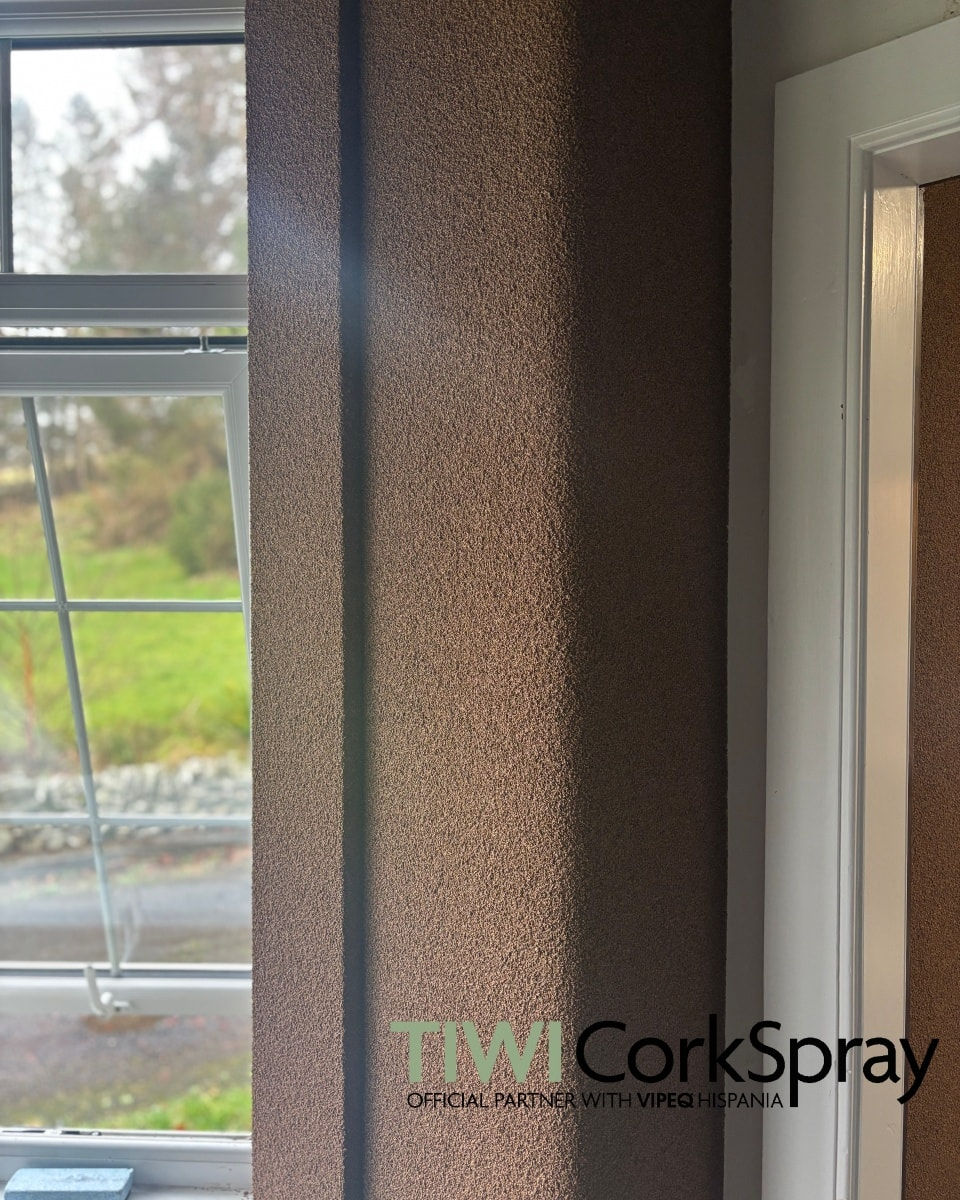
“How does it compare to PIR board?”
We get this one a lot. PIR retrofits can absolutely work, but they often come with a lot of hidden “after work” and landfill waste. Once you start adding boards you’re usually into moving sockets, extending window reveals, adjusting skirtings and architraves, re-lining, re-finishing, and coordinating multiple trades.
Any small gap or weak detail can become a cold bridge or condensation point, and on solid wall homes you also have to think carefully about breathability and moisture behaviour so you don’t trap damp where the wall needs to dry.
Spray Cork and Cork Plaster systems are different. They’re thin, seamless and can be applied into awkward areas without rebuilding half the room, which means less disruption, fewer follow on trades, and far less to almost zero waste. They also suit a more breathable approach for older solid walls, and they’re often used specifically to target the real world problem zones on external walls, where in some scenario's board systems are hardest to detail properly.
PIR is a rigid board insulation, normally used within stud work or behind plasterboard systems. It’s typically not breathable, and it often includes foil facings designed to prevent moisture and vapour movement.
PIR has a strong lambda value, commonly around 0.022 W/mK.
Cork plaster isn’t trying to be PIR, on paper with numbers it wont compete either..
A cork plaster system is an entirely different product installed in a entirely different way, a breathable, seamless coating approach that targets comfort, cold bridging and condensation risk in real world solid wall homes.
So a straight “mm for mm” comparison is usually misleading because:
The systems behave differently with moisture
The junction detailing is different (reveals, corners, lintels)
The outcomes people care about aren’t always just U-value
Natural structure and why cork behaves differently
Cork is made up of two key cellular components often referenced in cork science: lignin and suberin.
Those natural cellular structures are part of why cork is:
Lightweight
Resilient
Naturally resistant to moisture and decay
Yes, our products are made from natural materials rather than synthetics. That matters in a comparison too, especially for older buildings where breathability and compatibility are important.
What thickness do we actually install?
Here’s the practical answer.
On a recent job installed by a certified installer Scott Wylie from business and plastering company ''fat boy skim", the product applied was at around 5-6mm.
Our recommended "minimum" is 3mm for that product used, beyond that, the right thickness depends on:
The surface condition (flatness, suction, existing paint/plaster)
The problem you’re solving (cold spots, mould, comfort, airtightness)
The areas you’re targeting (full walls vs reveals/returns)
Space in and round the area
Budget in around other trade works after the installation or insulation
Where cork coatings make the most sense
Cork isn’t the answer in every scenario.
But in the right scenario, it’s a very effective solution, especially for:
Solid wall homes with recurring condensation and mould
Window reveals, bay returns and other cold bridge hot spots
Projects where you can’t afford to lose lots of internal space
Homeowners who want a breathable, natural build-up
landlords that have persistant cold ingress problem and mould
What is the U-Value of Cork Plaster and Cork Spray?
U-value is different because it’s the performance of the whole wall build up, not just the material and our materials are in a wet form. It’s also affected by junctions, air gaps, fixings, workmanship, and how the wall handles moisture.
That’s why real world results aren’t just a “mm vs mm” comparison too.
Final thoughts and honest advice
PIR has an excellent headline lambda (often around 0.022 W/mK), one of the best in fact, so mm for mm it will usually beat a cork coating on pure thermal resistance, but PIR is a rigid board system, typically used with foils, tapes and plasterboard build-ups, and it relies heavily on perfect detailing to avoid gaps, thermal bridging and moisture issues. Cork spray coatings, spray cork solutions and cork plaster systems in the UK aren’t trying to be a type of PIR.
They’re thin, seamless, breathable cork systems that can be applied where boards struggle improving internal surface temperatures and helping reduce the conditions that lead to condensation and mould, they also prevent heat pass through and cold ingress.
So yes, the lab numbers matter, but real world performance is also about continuity, junction detailing and how the wall manages moisture. Plus, cork is a natural, low-VOC material choice with a much lighter environmental footprint than petrochemical foams.
We’ll always be straight with you. If cork isn’t the right fit for your home, we’ll tell you and point you in the right direction.
If you want a recommendation, use our contact form link in the box below
And we’ll tell you what makes sense for your scenario, and whether a TIWI cork plaster system is the right approach.
Simply click the Get in touch link below.


